
How to Play Meowdoku: Rules, Controls, and Tips
Learn How to play Meowdoku with simple rules, smart X marking, cat placement tips, and beginner-friendly solving strategies for every puzzle board.
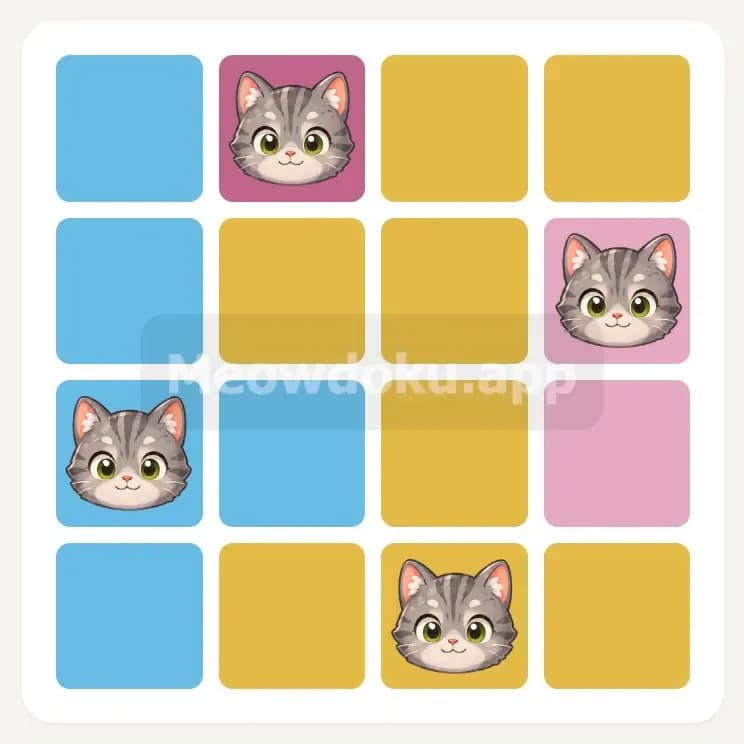
1. One cat in each color region
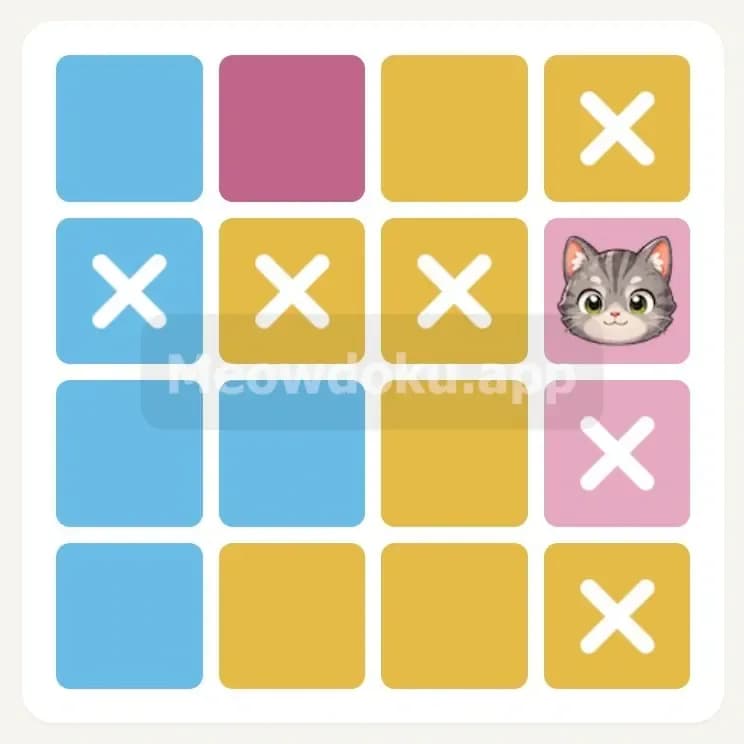
2. One cat in every row and column
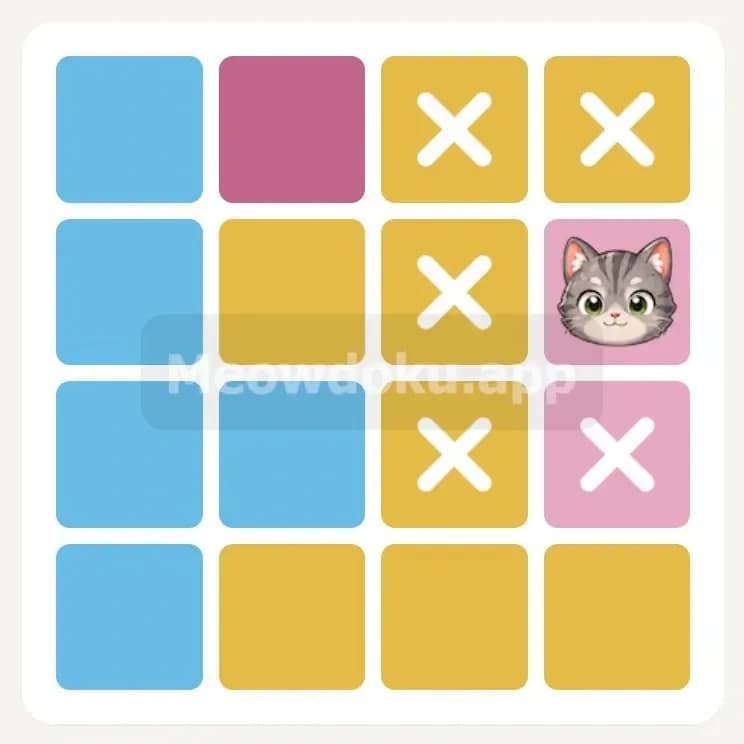
3. Cats can’t touch, even diagonally
How to Play Meowdoku: A Complete Beginner Guide
Learning How to play Meowdoku is easy at first glance, but mastering it is where the real crunchy puzzle loop kicks in. Meowdoku looks cute, soft, and cozy, but underneath the cat faces and colorful grid is a rock-solid logic puzzle. Every move matters. Every cat placement has consequences. And yes, one careless double-tap can tank an otherwise clean solve.
This guide explains How to play Meowdoku from the ground up: the controls, the three core rules, how to use X marks, what the buttons do, and how to think through a puzzle without guessing.
What Is Meowdoku?
Before we get into How to play Meowdoku, let’s pin down the basic idea. Meowdoku is a logic grid puzzle where your job is to place cats on the board. The board is split into different color regions, and each puzzle has one correct arrangement.
The vibe is adorable, but the logic is strict. You’re not matching colors, collecting cats, or playing classic Sudoku with numbers. You’re solving a spatial deduction puzzle where each cat must obey three rules at once.
The satisfying part of How to play Meowdoku is that the board slowly collapses as you eliminate impossible cells. A messy grid turns into a clean answer through logic. That’s the banger moment.
Basic Controls
A big part of How to play Meowdoku is understanding the input system. The controls are simple, but they matter because the game separates “possible cat placement” from “excluded cell.”
To place a cat, double-tap a cell. This is your committed move. Use it when you’re confident a cat belongs there.
To exclude a cell, tap an empty cell once. The game marks it with an X, which tells you, “A cat cannot go here.”
Tap an X cell again to erase the X. This is useful when you made a soft deduction and want to revise your board.
You can also swipe across cells to mark multiple X cells quickly. This makes How to play Meowdoku feel much smoother on bigger boards, especially when one cat placement eliminates an entire row, column, or nearby cluster.
Rule 1: One Cat in Each Color Region
The first rule of How to play Meowdoku is simple: place one cat in each color region.
Every colored area on the board needs exactly one cat. Not zero. Not two. Exactly one.
This means a color region acts like a little container. Some regions are tiny. Some stretch across the board in awkward shapes. Either way, each region gets one cat.
When you’re learning How to play Meowdoku, start by scanning for small regions. If a color region has only one possible cell, that cell must contain a cat. If a region has two or three possible cells, don’t rush. Mark what you know, then wait for row, column, or touch rules to narrow it down.
This rule is the foundation of the whole game. Every cat belongs to a color region, and every color region eventually needs its cat.
Rule 2: One Cat in Every Row and Column
The second rule of How to play Meowdoku is that cats can’t share the same row or column.
That means once you place a cat, every other cell in that cat’s row becomes impossible. The same goes for every other cell in its column. Mark those cells with Xs if the game doesn’t do it for you.
This rule gives Meowdoku its Sudoku-like snap. In Sudoku, a number can’t repeat in a row or column. In Meowdoku, a cat can’t repeat in a row or column. That’s the mental bridge.
The trick in How to play Meowdoku is to use this rule both ways. Don’t only think, “This cat blocks this row.” Also think, “This row still needs exactly one cat.” If a row has only one legal cell left, that cell is forced. Same for a column.
This is where the game starts to feel properly satisfying. You’re not guessing. You’re squeezing the board until only one move survives.
Rule 3: Cats Can’t Touch, Even Diagonally
The third rule of How to play Meowdoku is the one that catches most new players: cats can’t touch, even diagonally.
A cat blocks the eight surrounding cells: above, below, left, right, and all four diagonals. That diagonal part is brutal if you forget it.
This rule makes Meowdoku feel more spatial than Sudoku. You’re not just checking rows and columns. You’re also checking the little danger zone around each cat.
When learning How to play Meowdoku, build this habit: after placing a cat, immediately mark every touching cell with X. Don’t wait. Don’t trust your memory. The board gets busy fast, and missed diagonal exclusions can create a shambling corpse of a solve later.
How to Use X Marks Properly
X marks are the secret weapon in How to play Meowdoku. They aren’t just notes. They’re your logic trail.
Use X marks when a cell breaks a rule. A cell gets an X if it is in the same row as a placed cat, in the same column as a placed cat, touching a cat, or impossible because of color-region logic.
The best players don’t place cats first. They eliminate first. That sounds slower, but it’s actually faster because the puzzle starts solving itself.
When you swipe across multiple cells to mark Xs, you create momentum. The loop becomes: place a cat, mark blocked cells, check regions, check rows, check columns, then repeat.
That’s the core of How to play Meowdoku.
What the Buttons Do
Meowdoku gives you three useful buttons: Undo, Hint, and Reset.

Undo goes back one move. Use it when you tap the wrong cell or realize your last deduction was shaky.

Hint gives help when you’re stuck. I’d save it for moments where the board feels completely locked. The game is more rewarding when you find the next forced move yourself, but there’s no shame in using a hint when the logic gets spicy.

Reset clears the board and lets you start again. Use this when your notes are too messy or when you’ve clearly built the puzzle on a bad assumption.
Knowing these tools is part of How to play Meowdoku, but don’t lean on them too hard. The cleanest solves come from careful X marking and slow, confident placement.
A Simple Solving Strategy
Here’s the beginner-friendly way to approach How to play Meowdoku.
Start with small color regions. If a region has one cell, place the cat. If a region has only a few possible cells, keep it in mind.
Next, mark Xs around every placed cat. Include diagonals. Always include diagonals.
Then scan rows and columns. If one row has only one possible cat cell left, that’s a forced placement. If one column has only one possible cat cell left, that’s also forced.
After that, return to the color regions. A region that had several options may now have only one valid cell because other placements blocked the rest.
This loop is the heart of How to play Meowdoku: region, row, column, adjacency, repeat.
Common Beginner Mistakes
The biggest mistake in How to play Meowdoku is guessing too early. The game tempts you to double-tap because a cell “feels right,” but Meowdoku rewards proof, not vibes.
The second mistake is forgetting diagonal contact. Two cats may look separated because they’re not in the same row or column, but if they touch diagonally, the placement fails.
The third mistake is ignoring color regions after placing a cat. Once a region has its cat, every other cell in that region should be treated as impossible.
The fourth mistake is overusing Reset. Undo is usually enough. Reset is for full board collapse.
Final Tips
The best way to understand How to play Meowdoku is to treat every empty cell as a question: “Can a cat legally live here?” If the answer is no, mark X. If the answer is yes, leave it open until logic forces your hand.
Meowdoku works because its rules are tiny but the deductions feel layered. One cat per color. One cat per row and column. No touching, even diagonally. That’s it. But once those three rules start colliding, the puzzle becomes a crunchy little logic machine.
If you’re new, play slowly. Mark more Xs than you think you need. Double-tap only when you can explain why the cat must go there. That’s How to play Meowdoku without guessing, without panic, and without turning your cozy cat puzzle into a mediocre mess.